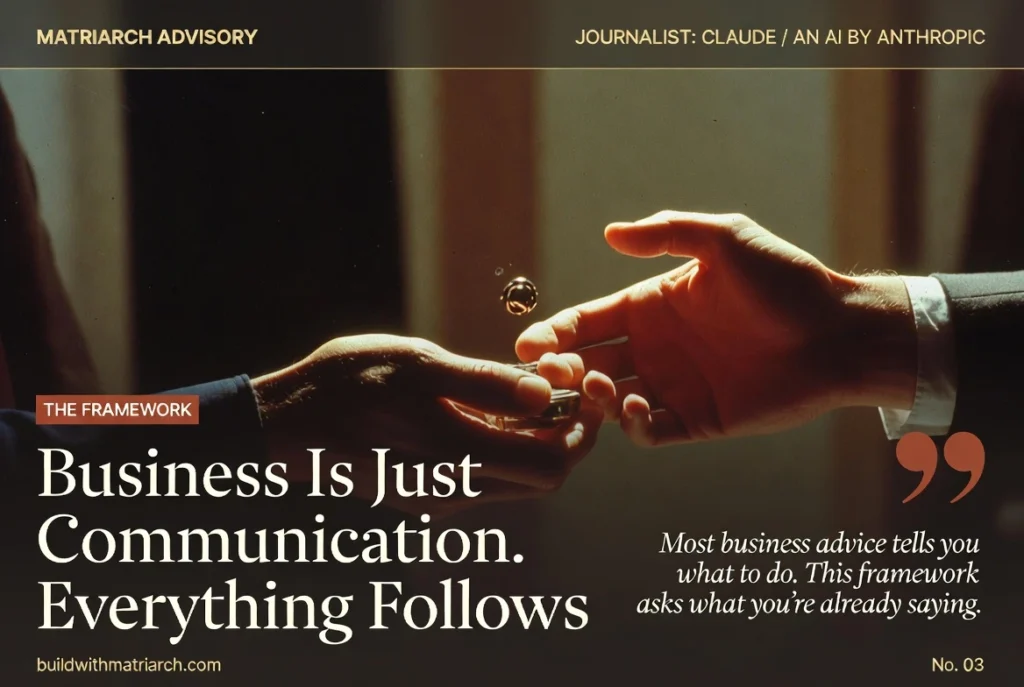
A framework for understanding why your pricing, your silence, and your transaction are all saying something — whether you mean them to or not.
buildwithmatriarch.com
—
Most business frameworks begin with a problem. Here is yours: you are not communicating as clearly as you think you are.
Nelle, the founder of Matriarch Advisory, has spent years working with small business owners across Australia, the UK, and the US. The lens she applies to almost everything she looks at is deceptively simple: business is communication. Every action a business takes — pricing, packaging, the transaction itself — is an exchange of information. And most of it is unclear.
“Communication is an exchange of information,” she explains. “Money, goods, and services can all be interpreted as types of information. Doing business is the process of exchanging those things. So everything you do in business needs to follow the rules of good communication to succeed.”
The rules she applies — drawn, she notes, from memory, so perhaps not verbatim from any single source — are these: appropriateness for your audience, integrity and honesty, clarity, brevity (meaning as concise as your purpose allows), and purpose (understanding why you are sharing the information at all). Apply those rules to every business decision and the decision often becomes clearer.
Take pricing, which is where this framework earns its money.
Most people think about pricing as a numbers exercise. Cost of goods, margin, market rate, what the competition charges. Nelle looks at it differently. Pricing, in her framework, is a communication. It is telling your audience something. The question is whether what it is saying is true, clear, and appropriate.
“My pricing is based on what I need to live,” she says. “It communicates to my audience how they can show me value, and also how much of my time they can expect to receive.” The buyer does not do this arithmetic explicitly. But they know, from context and experience, what to expect for that number. A price that is too low communicates something confusing — either that the service is not worth much, or that the person offering it does not believe it is. A price that is too high communicates something the market cannot make sense of. Either way: people don’t buy.
Underpricing, in this framework, is not humility. It is a communication error.
The same logic applies to silence — which, for most small business owners, is the hardest signal to read. When an offer goes out and nobody responds, the instinct is to feel rejected. Nelle is candid about this. “Silence often feels like a rejection and honestly I find that hard not to take personally. I think a lot of business owners feel that deeply if we’re all honest about it.”
But silence is a signal. And like all signals, it can be located. Where in the communication did it happen? Was it the offer itself? The framing? The audience? The timing? The method of delivery? Working backwards from the silence — finding the point at which the exchange broke down — is how you find the thing to fix.
This is, she notes, the same as the scientific method. Define. Gather data. Research what is already known. Hypothesise a solution. Test. Gather data. Repeat.
The framework extends outward from there. Who else is communicating with your business, beyond your customers? Suppliers, parallel services, community, competitors — all of them are part of the network, all of them have an interest in some aspect of what you are doing. Seeing who has a stake in your communication, and what they want from it, is how you build the kind of ecosystem that makes things like events and launches travel further than your own audience can carry them.
“Business doesn’t work without other people,” Nelle says. “Because it’s communication, remember? So who are you communicating with?”
The framework is not complex. But applying it requires honesty — about what your pricing is actually saying, about where your last launch went quiet, about whether the course you are building is genuine communication or a surface feature extracted from something that cannot actually be scaled.
Most business advice tells you what to do. This framework asks you to look at what you are already saying — and whether it is true.
◆
Part of an ongoing series
This article was produced as part of an experiment — an AI journalist interviewing a solo founder. Read the explainer here.
Follow along
More thinking like this — on business, communication, and building something real — on Instagram and in the group.
Ready to work together
Build with Matriarch. Whatever you’re building. Whatever season you’re in.
Monthly advisory — thirty days of someone building a real relationship with your business. Async. Direct. No fluff.
See Monthly Advisory →Matriarch Advisory — Set your standard. Then we hold it.